
Trucks top traffic cops’ list for e-challan recovery
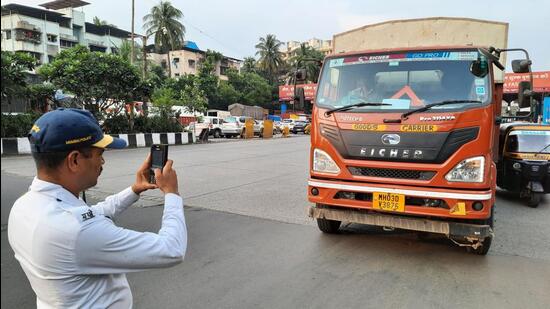
Next on their list are taxi operators, including Ola and Uber drivers and also those associated with online delivery apps like Swiggy, Zomato etc. “We plan to focus on commercial vehicle owners because they account for around 70 per cent of the total traffic violations
Rajvardhan Sinha, joint commissioner of police (traffic) said, “We have started this process as an experiment in case of heavy vehicles which enter the city during peak hours -- between 8 to 11am and 5pm to 9am. Each vehicle is stopped and checked for pending e-challans and if any vehicle is found to have faltered, they are not allowed to proceed further, until the fines are paid in entirety.”
Next on their list are taxi operators, including Ola and Uber drivers and also those associated with online delivery apps like Swiggy, Zomato etc. “We plan to focus on commercial vehicle owners because they account for around 70 per cent of the total traffic violations,” said Sinha.
If vehicle owners are unable to pay up the hefty dues, a surety will be taken to ensure that they pay the penalty within 48 hours.
In the last phase, the department will crack down on private vehicle owners.
These decisions have been taken because the Mumbai traffic police believe that e-challans, first introduced in 2016 to act as an effective deterrent for errant motorists and also stem incidences of bribery amongst traffic cops, have outlived their shelf-life of being a deterrent.
One of the main reasons why the mandate has lost its sheen is because the Regional Transport Office (RTO) often does not have the correct mobile numbers or addresses of vehicle owners. The registration details are also not linked to the respective Aadhar Cards or other authentic government documents, making the process of recovery tedious.
He said that the RTO just cancels the licenses and does not have the required space to keep in the vehicles impounded. Another challenge to trace the vehicles, Sinha said, is that scores of those running in Mumbai are registered outside the city.
“Tracking down vehicles registered outside the city or the state becomes a challenge,” said Sinha. He also pointed out that unlike in the West, the vehicle owner’s bank account details are not linked to the registration number – such a provision is absent from the Central Motor Vehicle Act. If this system were introduced here, the fine amount could be directly debited when a traffic violation is committed by the vehicle owner.
While Lok Adalats are reassuring, said Sinha, the entire process leading to the recovery is comparatively slow. The purpose of the exercise is to enforce discipline on errant motorists, which would lead to better traffic conditions within the city and ensure safety on roads. It would also indirectly help in containing the considerable number of fatalities on the roads, emphasised Sinha.

टिप्पण्या
टिप्पणी पोस्ट करा